The Hidden Budget: How Gambling Quietly Drains Your Money

Where Is Your Money Really Going?
Maybe you have told yourself that you are just bad at budgeting. Maybe you have blamed inflation, unexpected bills, or not earning enough. Maybe you have genuinely tried to get back on track, only to find yourself short again by the middle of the month. You pay something down, then somehow the pressure comes right back. The credit card creeps up again. The checking account gets thin again. The stress returns.
Part of you likely already realizes gambling is a factor.
But maybe you do not realize just how much it is costing you.
That is one of the most difficult truths about gambling-related financial problems: the money often disappears in ways that are easy to miss. It is not always one giant transaction labeled “gambling.” It is often spread out across ATM withdrawals, cash back at the store, online gaming apps, debit card charges, credit card advances, peer-to-peer payment apps, and cash that disappears without much tracking. One transaction may not seem like much. But when you add them all together, the number can be startling.
That is what I call the HIDDEN BUDGET.
It is the amount of money gambling is taking from your life each month without being fully seen, named, or planned for. And until that hidden budget becomes visible, it can quietly keep wrecking your financial stability.
Why it is so hard to see
If gambling has become part of your financial life, there is a good chance the spending does not feel neat or obvious.
You may take out $100 at an ATM one day, throw $40 cash back onto a grocery purchase another day, make a small deposit into an app on the weekend, use a credit card late at night, then move money around to cover bills afterward. It can feel scattered. Random. Hard to track.
That is part of why gambling can stay hidden for so long.
Unlike rent, a car payment, or your phone bill, gambling often does not show up in one clean category. It slips into your finances in fragments. A little here. A little there. Sometimes there are a lot. It can blend in with ordinary spending so well that even you may not realize how large the total has become.
This does not mean you are bad with money. It does not necessarily mean you are trying to fool yourself all the time. Often, it means you are operating transaction by transaction instead of looking at the full monthly picture. When you are in the cycle, you may be focused on getting through the moment, chasing a loss, escaping stress, or convincing yourself you will make it back. You are not sitting there calmly doing monthly math.
And shame makes it worse.
Shame tells you not to look too closely. Shame tells you to avoid statements, skip the math, and promise yourself you will “fix it next month.” Shame loves vagueness. Because as long as the number stays fuzzy, you do not have to fully face it.
But fuzzy numbers keep people stuck.
The story you may be telling yourself
Before you see the real numbers, you may have a completely different explanation for why life feels so financially hard.
You might tell yourself:
“I just do not make enough money.”
“I’m terrible with money.”
“I can never get ahead.”
“I need to budget better.”
“I have too many bills.”
Sometimes those things are partly true. Life is expensive. Income may be tight. Budgeting skills may need work. But when gambling is involved, those explanations are often incomplete.
What looks like a general money problem may be a gambling problem with a money trail.
What looks like a failure to budget may be a hidden monthly drain that keeps knocking your plan off course.
What feels like chaos may be a pattern.
That matters, because if the real issue is hidden, your solutions will not work. You can download budgeting apps, listen to money podcasts, and swear you are going to do better but if gambling is still quietly taking $500, $1,000, $2,000, or more each month, your plan is trying to survive with a hole in the bottom of it.
That is not a character flaw. That is math.
The moment the hidden budget shows up
In many financial counseling sessions, the real turning point happens when we rebuild the spending plan.
We go line by line.
We look at the bank account.
We look at the debit card.
We look at the credit card.
We look at the ATM withdrawals.
We look at the cash.
We look at the apps.
We look at the transfers.
And then it starts to come together.
This is where many people have that gut-punch moment. Not because they did not know gambling was a problem, but because they did not realize the full monthly cost. When the transactions are scattered, it is easy to underestimate. When they are mapped out in one place, the truth gets harder to hide.
That moment can feel brutal.
It can also feel relieving.
Because once you can see the number, you can stop blaming yourself in vague, hopeless ways. You are no longer stuck with a foggy sense that you are just failing at adulthood. Instead, you can say: This is what has been happening. This is where the money has been going. This is why I have not been able to get traction.
Clarity can hurt, but it also gives you something powerful: a starting point.
Why seeing the truth matters
You cannot build a realistic financial plan around numbers that are incomplete.
If gambling quietly consumes part of your income every month, then any budget you create without accounting for it is going to feel impossible. You will keep wondering why the plan is not working. You will keep feeling like you are weak, lazy, or irresponsible. Meanwhile, the real issue stays in the shadows.
When the hidden budget becomes visible, everything starts to make more sense.
Maybe the reason your credit card balance never goes down is not because you are hopeless with money. It is because gambling keeps eating the money that would have gone toward payoff.
Maybe the reason your checking account is always tight is not because groceries are the problem. It is because repeated small gambling transactions are draining your cushion.
Maybe the reason you keep falling behind is not because your goals are unrealistic. It is because gambling has become an invisible monthly bill.
And unlike your IRA contribution, this one does not improve your life.
What rebuilding looks like
Once you know the real number, the next step is not to punish yourself. It is to stabilize.
That means getting clear on your essentials first: housing, utilities, food, transportation, insurance, child-related expenses, medications, and minimum debt payments. Those come before everything else.
Then you build from there.
This is where recovery changes your finances in a very real way. Because when gambling spending is reduced or stopped, money that used to disappear can finally be redirected toward something meaningful: catching up bills, paying off debt, rebuilding trust, creating savings, or simply being able to breathe at the end of the month.
That is a big deal.
You may be used to thinking of recovery only in emotional or behavioral terms, but it is financial too. Recovery is how you stop living in constant damage control. Recovery is how you stop having to shuffle money around, hide transactions, rely on credit, or dread checking your balance.
Recovery creates room.
Not overnight. Not magically. But steadily.
And often, it starts with some very practical changes:
- reducing access to cash
- limiting credit
- blocking or deleting gambling apps
- creating accountability with a trusted person
- tracking transactions more closely
- planning for what happens when the urge to gamble shows up.
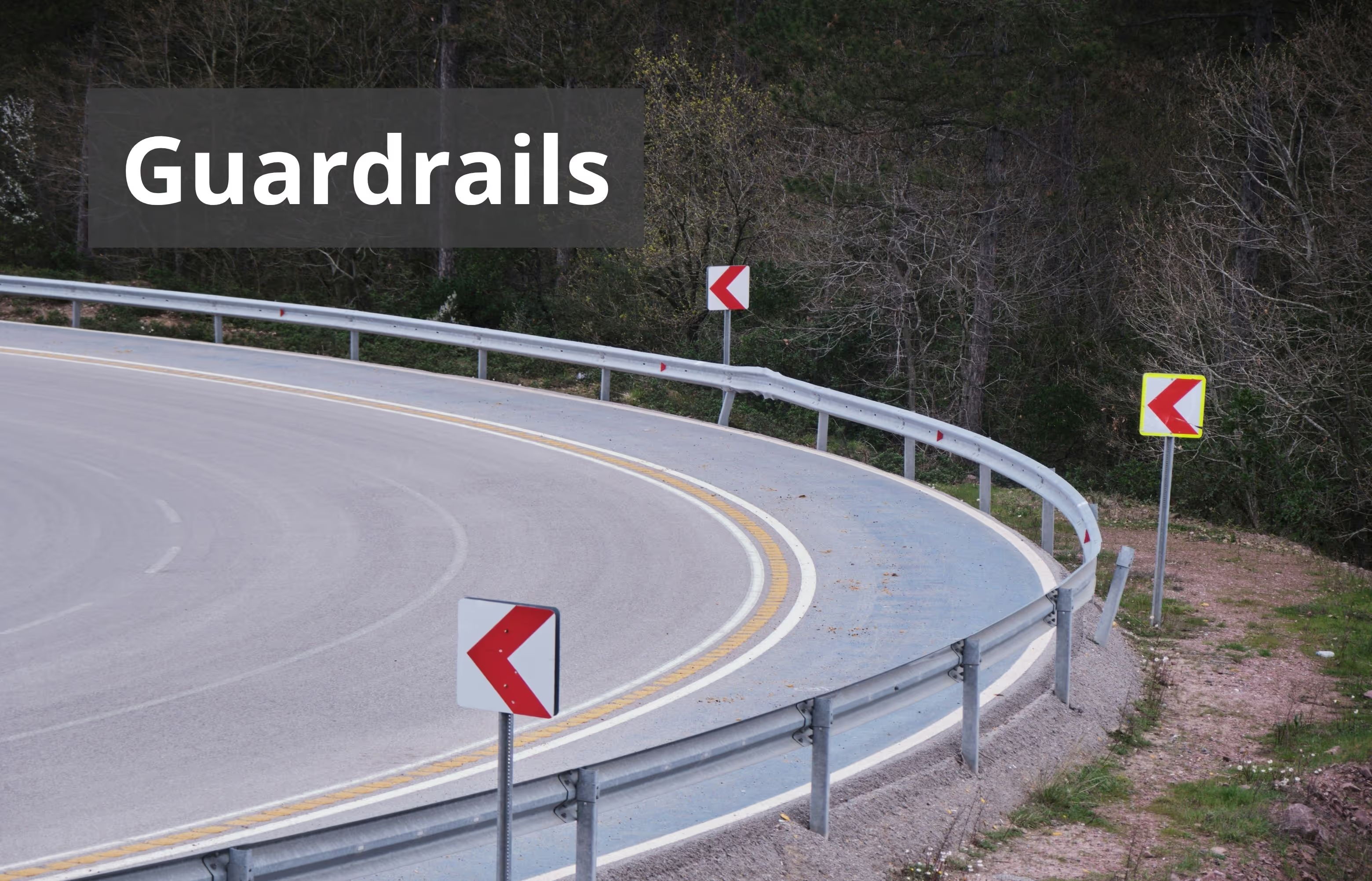
This is not about being treated like a child. It is about creating structures while you rebuild. Plenty of smart, capable adults need guardrails in recovery. Guardrails are not weak. They are supportive.
What gambling may be costing you
The real cost of gambling is usually bigger than the bets themselves.
It can include ATM fees, overdraft fees, interest charges, late payments, cash advances, increased credit card debt, missed savings, unpaid taxes, relationship strain, and the emotional exhaustion of trying to keep everything afloat.
It also steals your financial attention.
Instead of planning ahead, you are reacting.
Instead of building security, you are plugging holes.
Instead of using money to support your life, you are using your life to support the gambling cycle.
That is exhausting.
And if you have been living in that cycle for a while, you may have forgotten what financial peace even feels like. You may have gotten so used to crisis that calm feels unfamiliar.
But calm is possible.
This is not the end of your financial story.
Let me say this clearly: if gambling has damaged your finances, that does not mean you are beyond help. It does not mean you are doomed to be financially reckless forever. It does not mean you are incapable of change.
It means there is a pattern that needs to be named honestly.
Once that pattern is visible, you can work with it. You can get support. You can create systems. You can rebuild. You can learn how to handle money in a way that is grounded in reality instead of shame and secrecy.
The first step is not having all the answers.
The first step is being willing to look.
To look at the statements.
To look at the withdrawals.
To look at the apps.
To look at the transfers.
To look at the credit cards.
To look at the truth.
Not so you can beat yourself up, but so you can finally stop guessing.
Because when you uncover the hidden budget, something important happens, gambling loses some of its power to stay vague, quiet, and in control. It is no longer operating in the shadows, like an invisible bill that keeps hijacking your life.
Now it has a number.
Now it has a pattern.
Now it can be addressed.
And that is where real financial recovery begins.