The Bank Sees Gambling Harm Before the Therapist Does
1-800-GAMBLER. You've seen it at the bottom of every sportsbook ad, in tiny font, at the end of the commercial during the game.
Ever wonder what happens when someone actually calls it?
They're in crisis. That call is rock bottom. Nobody dials that number on a decent day... They dial it after they've lost more than they can afford, and usually after they've hidden it from a spouse or a parent for months, if not years.
And last year, 73% of those conversations were about money. Gambling debt. Drained savings. A tax or utility bill they can't pay. Money is the number one reason people reach out, ahead of anything else... and it's the thing the person answering the phone is least equipped to help with.
Here's the part our industry has missed: By the time that call happens, the harm has already moved through a checking account, a debit card, a payment app. Somebody's systems processed every one of those transactions... And none of these patterns got flagged.
This Friday, I'll be in New York City making that exact case at Finovate IMPACT. I made it last year on Alex Johnson's Fintech Takes podcast too. Since then I've put these numbers in front of a lot of audiences, and nobody argues with the premise anymore. Instead, they're asking what to do about it. A much better question.
So let me lay it out.
Financial health is mental health
Nowhere is that clearer than gambling addiction.
Nine million US adults struggle with a gambling problem. The American Psychiatric Association recognizes gambling disorder as a mental health diagnosis. It is not a character flaw and it is not a budgeting mistake.
And read the diagnostic criteria. Two of them are about money. "Relying on others to help with money problems caused by gambling." "Lying to hide the extent of gambling involvement." The financial damage isn't downstream of the disorder, it's part of how the disorder is defined. The APA's own list of what counseling should accomplish includes "put your finances in order."
Only one in ten people with gambling disorder ever seek treatment.
This disorder is also lethal. People with gambling disorder die by suicide at about five times the general population rate. Debt and the shame around it are among the main reasons why.
Sit with that for a second... because it's the whole argument. The clinical risk and the financial crisis are the same crisis. We just built two separate industries to handle them and neither one talks to the other.
The money problem is bigger than people think
Americans legally wagered $167 billion on sports last year. The books kept about $17 billion of it. Across all of commercial gaming, casino floor plus sports betting plus online, the industry took in $78.6 billion, a sixth straight record year, and paid $17.9 billion in gaming taxes. Add tribal gaming and the real number is closer to $125 billion. (And none of that includes prediction markets, which is where Part II picks up.)
Sports betting is legal in 38 states now, 30 of them online, in the eight years since the Supreme Court cleared the way.
That growth happened fast and it happened mobile-first. Betting today looks less like a trip to a casino and more like any other app on your phone. Funded from a checking account. A few taps. Always open.
And it shows up on balance sheets. The New York Fed looked at household credit after legalization and found deterioration, on $520 billion wagered since 2018. Their words: sports betting "can have dramatic implications for household financial stability." An NBER study of 230,000 households across 26 states found deposits into brokerage accounts dropped 14% after legalization, with credit card debt and overdrafts rising among households that were already constrained. Last November, Bank of America started naming which consumer lenders are exposed.
So this is not only a customer harm story. If you're a bank, a credit union, a card issuer, or a lender, it's a credit risk story. And it's already in your portfolio.
The gap
All of this activity runs on the same infrastructure as everything else in a person's financial life. A checking account. A debit card. A peer-to-peer payment app. Every bank, card issuer, credit union, and neobank in the country is touching it, every single day.
It has just never been asked to notice it as its own category. Fraud patterns get flagged. Overdraft trends trigger alerts. This doesn't.
That's not a knock on any one institution. It's a blind spot the whole industry shares, and it's one we can fix.
Meanwhile nobody upstream is catching it either. Only 15% of Americans have ever been asked about gambling by a primary care doctor. In claims data, diagnosed gambling disorder shows up at about 6 cases per 100,000 people, while the prevalence research puts it somewhere between 1% and 6% of adults.
That gap isn't good news. It means almost nobody is being identified at all.
And it stays hidden at home. Only half of parents in betting households say they know how much their partner is actually betting. A third of those households have cut essential spending to place bets or cover losses.
Which leaves the transaction data. It is very often the only honest record of what's happening.
To be clear about what detection means here, it isn't the presence of a bet. Plenty of people bet $40 on a Sunday and are fine. It's velocity and escalation: deposits getting bigger, getting closer together, starting to come from credit instead of cash, showing up at hours that don't look like entertainment. That's a pattern, and patterns are what this industry is already good at reading. (We're building that detection layer ourselves, in Guardian.)
The uncomfortable part
Here's the part that gets the most pushback, every time:
A lot of what makes betting apps so effective isn't unique to betting.
Instant funding. Frictionless re-engagement. Rewarding the exact behavior you want repeated.
Parlays are the purest version. Bet $100 on a straight bet and the book keeps about $5 of it. Bet it on a parlay and the book keeps five to six times that. Parlays are what the apps are built to push.
That isn't a gambling-industry invention. It's a page from the same playbook plenty of fintech products use to drive daily engagement.
I'm not saying every fintech app is a sportsbook in disguise. I'm saying the engagement mechanics are shared. And an industry that understands those mechanics well is exactly the industry that should be paying attention to how they're being used to cause harm.
(This one is my opinion, not a study. I'm comfortable with it. We build products too.)
Where this started for me
My path here wasn't academic.
Early in my career, I went looking for help with my own financial problems and I learned how the advice business actually works. Advisors get paid on assets under management, or on commission from the products they sell. Do the math on that. If you carry debt and hold no assets, you don't generate revenue for them. You're just not who that business was built for.
So you do what anybody does. You search online. And when you're in distress and looking for help, the easiest things to find are the worst ones. Debt settlement. Credit repair. Anybody who figured out that a person in that situation will pay for hope.
That's where MoneyStack, the company behind GamFin, started.
What I didn't expect was how much sharper that gap gets when the debt comes from gambling. Shame keeps people quiet. Standard budgeting advice falls apart when you're chasing losses, desperate to get even. And most financial counselors, understandably, have never been trained for any of it.
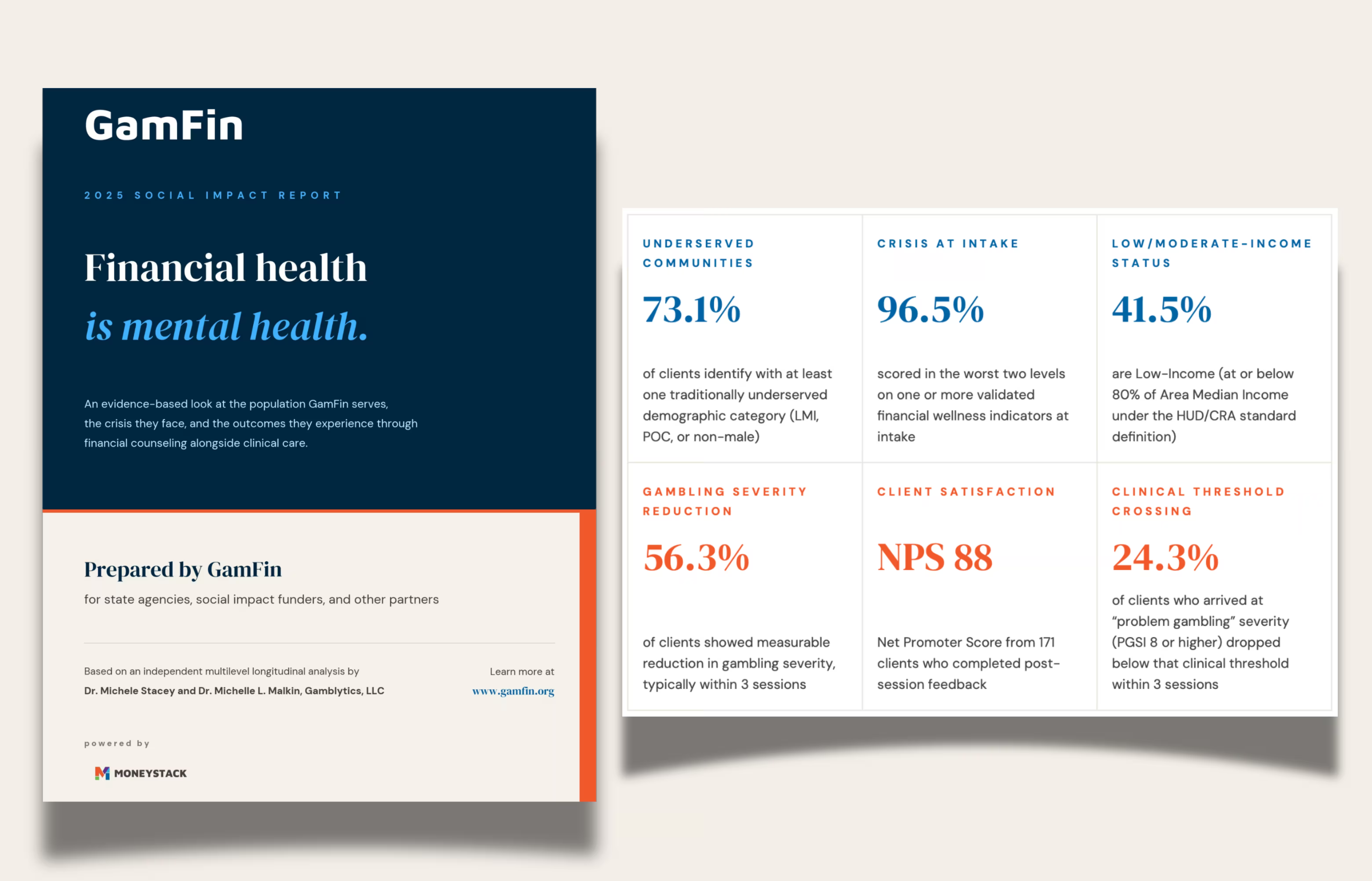
That's what GamFin is for. Financial counseling built for this specific situation, delivered alongside clinical treatment, and funded through state agencies and other third-party payers so it isn't one more bill on top of everything else someone is struggling with. Nineteen states pay for it out of gambling tax revenue, and a growing number of provider organizations fund it themselves. Two-plus years in, we've served 2,000 clients. And in three sessions, 56% of the clients we've measured show improvement on the standard gambling severity screener.
One thing that surprises people: this is not a low-income problem. 65% of our clients earn between $50K and $150K. 10% earn over $200K.
The simplest way I know to describe what we do... healthcare people don't speak money, money people don't speak healthcare, and we're the platform that lets them talk to each other to support clients.
Why I'm saying this to financial services professionals
Because you see it first.
The overdrafts. The cash advances. The transfer to a sportsbook at two in the morning. You see the financial harm as it happens, live, months before any therapist does. That makes you first responders, whether or not anyone has framed it that way before.
I made a version of this argument at EMERGE in May 2026, to a room of financial health people, and I'll make it the same way here. Somebody comes to you for a hardship withdrawal, a 401(k) loan, or help with unreported gambling winnings on last year's taxes. Don't just process the request. Ask why, without judgment. Then offer to connect them to someone.
The sportsbooks run responsible-gaming programs, and I'd point out what those programs structurally cannot do. A single operator only sees the money a person loses on that one app. Someone in trouble is usually spread across several licensed platforms, plus offshore sites that answer to nobody, plus crypto moving out and coming back in as deposits when they finally win something. No operator sees that. You do. You see the paycheck land and where all of it goes, across every platform, legal or not.
I'm not asking anyone to diagnose anybody. Clinicians do that. I'm saying that when you see the pattern, or you're talking with a client in distress and gambling comes up, you now have somewhere to send them: refer them book an intake appointment with us. In the nineteen states where our work is funded, it costs your customer nothing and it costs you nothing.
What's coming in Part II
I've been watching one trend closely over the last year or so: people using investing and trading apps as the venue for the same behavior that used to happen only on sportsbooks. And how much harder that makes the line between betting and investing to see, both for the person doing it and for the institution watching the transaction go by.
I mentioned it as one to watch back in 2025, and again at the Urban Institute in March 2026, where I asked the researchers in the room for something nobody has: data on how spouses and parents see this, not just the people placing the bets. A year on, it's moving faster than I expected. Part II gets specific about it. Part III is what an institution actually does about all of this.
If you work in financial services and this is a conversation you're already having internally, or one you know you should be having, I'd like to hear from you. Email me directly at alex@moneystack.com.
Alex De Marco is the founder and CEO of MoneyStack, the financial counseling platform for behavioral health care. MoneyStack's program, GamFin, provides financial counseling for people struggling with financial problems caused by gambling, and for their families, funded through partnerships with state agencies and other third-party payers in more than a third of the country. You can listen to the full Fintech Takes conversation, Gambling, Finance, and the Fallout, from May 2025.
A note on how this was written: the ideas, the argument, and the experience here are mine. I used AI to help organize the draft, tighten the language, and check the numbers against my sources. I edited every line and I stand behind all of it.

.png)